Lean Startup Is Dying — What's Left Worth Selling Is Delivery
On July 26, at YC’s Startup School, Harj Taggar interviewed Stripe CEO Patrick Collison. Collison’s take: the lean startup playbook doesn’t really work in the AI era.
His exact words: the lean startup’s territory has been “aggressively tilled,” and the little niches are getting hard to find. He pointed to counterexamples too — many of the most successful companies of the past decade, whether the frontier AI labs or defense-tech Anduril, ran the opposite of lean: big, hard, capital-heavy bets from day one. His advice to founders was to “more aggressively de-correlate” — stop crowding into the same cracks as everyone else.
In the same interview he shared a number: new businesses registering on Stripe are up roughly 2x year-over-year, the largest relative jump in the company’s history.
Those two statements aren’t in tension. The second one is the cause of the first.
What was the premise of lean startup? That building things was expensive. When Eric Ries published The Lean Startup in 2011, shipping a product that could take money required a team working for months. Because the investment was costly, you needed an MVP, small iterations, validation before commitment — the entire methodology stood on one foundation: trial and error was expensive.
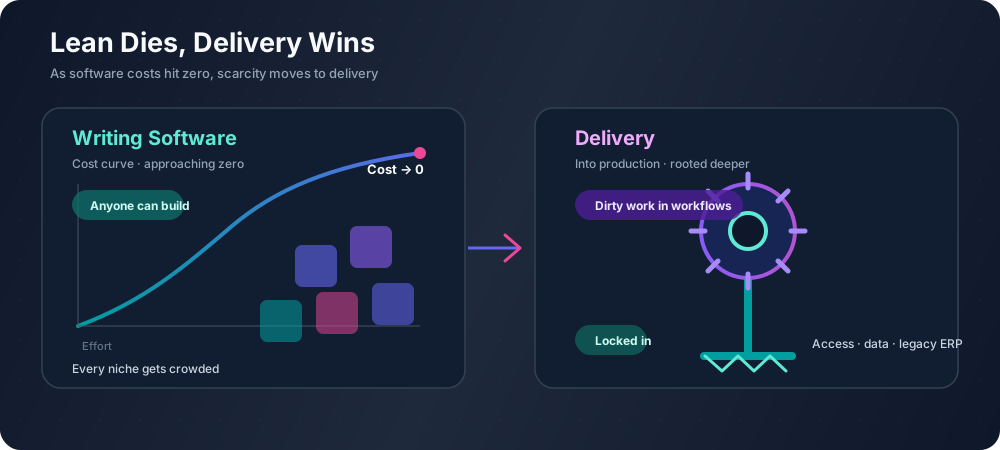
AI pulled that foundation out. The cost of writing software has collapsed toward zero, and Stripe’s doubling of new businesses is the evidence. What does 2x new companies mean? It means every niche you spot will have dozens of teams rushing in simultaneously. The MVP you spent two weeks building, someone else clones over a weekend. The lean method itself isn’t wrong — the scarcity it depended on is gone. When everyone can iterate cheaply, iteration is no longer an advantage.
So what’s still scarce? My call: delivery.
The software itself stopped being worth much, but getting software into a customer’s production process is still worth a lot. The customer’s access approvals, their dirty data, the ancestral ERP that’s been running for fifteen years, the interdepartmental turf wars — AI won’t handle any of that for you anytime soon. Someone has to be on site, filling in one pothole at a time.
This isn’t me speculating in a vacuum; the hiring market has already voted. The FDE — Forward Deployed Engineer — is a role Palantir invented in 2005: engineers who don’t sit at headquarters writing code, but embed at the customer’s site to do delivery. The model sat unloved for nearly twenty years. VCs always found it too heavy — headcount-driven, low margin, hard to scale. It looked like a bad business from every angle.
Now every AI company is copying it. OpenAI stood up its own FDE team in 2024, with job postings explicitly stating up to 50% of the time is spent embedded on customer sites; Anthropic, Google, and Databricks are all hiring for it too. Perspective AI, a recruiting-analytics firm, scanned roughly a thousand live job postings and found FDE openings grew 800% between January and September 2025, with year-over-year growth topping 1,000% by early 2026. Stack Overflow’s 2026 developer survey has another number: 41% of AI engineers now spend more than 30% of their time facing customers directly, up from 12% in 2023.
Why is a model nobody imitated for twenty years suddenly the thing everyone’s grabbing? I’d guess two layers.
First, AI changed the cost structure of heavy services. A deployed project used to require a full squad; now one FDE with a model behind them can cover half of what an old delivery team did. For the first time, heavy delivery can be both heavy and profitable. I haven’t seen public financials that prove this directly — call it a conjecture — but the speed at which the labs are expanding their FDE teams at least suggests the math works.
The second layer matters more: heavy delivery naturally locks the customer in. Once your engineer has soaked in the customer’s processes for six months — learned their data, their permissions, their org politics — switching vendors means paying that six months of friction all over again. The churn that SaaS companies lose sleep over barely exists in the FDE model. Not because the product is too good to leave, but because pulling it out hurts too much.
So if you’re in the software business now, stop asking “will the next model release casually absorb my product?” It will. That question doesn’t need asking. The one that does: the dirty work AI can’t do — are you willing to bend down and do it?
The barrier to writing software has collapsed. The barrier to walking into the server room still stands.
Sources: